



Find the answer to all your questions
Browse our guides and support — your one-stop hub for everything you need.
No answers found
Try a different keyword, or contact us.
Getting started
Yes. Products that show an order button go straight into your cart and can be ordered online. For everything else (and for custom requests) send us a request via the contact form and we'll prepare a quote right away. If you're unsure about anything, we're happy to help.
Transfers and badges are usually produced within 24 hours of order confirmation. Textile printing is usually completed within 3 working days. Production time depends on current workload and the size of your order — but we always aim for fast turnaround.
Every printing technology has its advantages and disadvantages — see our overview of printing technologies. If you can't decide or have no experience with a particular technology, we recommend an in-person or phone consultation so the result matches your expectations.
Capacity varies by technology. Each day we can produce up to 2,000 screenprint transfer sheets and up to 200 linear metres of DTF transfers, print up to 3,000 textile pieces, and make up to 3,000 badges. These are peak daily capacities — actual throughput depends on current workload and the size of your order.
For most technologies we can send you a reference sample. The sample won't carry your design but will be made with the chosen technology. The technology sample is free; you only cover the shipping cost via a proforma invoice.
If you need to modify or cancel an order, contact us by phone as soon as possible. Production often starts immediately after the order is received, so a change or cancellation can't be guaranteed.
Yes. You can combine different graphics and different products in a single order. Some products have their own rules (for example, badges must share the same size and we charge 3 € excl. VAT per additional graphic) — you'll see the specifics at each product.
The minimum depends on the product and is shown at each product. Most products can be ordered in small quantities; some have a minimum for production reasons (for example DTF transfers from 20 cm of length, badges from 30 pieces). If you need less, note it in the order and we'll calculate the price at that minimum.
Account & company
You can register in seconds with your Google account or with an email and password. An account gives you order tracking, express checkout with saved addresses, access to company pricing, our loyalty program and discounts, and the full history of your orders in one place.
No. You can order without registering — just choose "Continue without registration" at checkout. Without an account, though, you'll miss out on order tracking, express checkout with saved addresses, company pricing, our loyalty program and discounts. With an account it's all in one place.
In your company settings you can add your CRN, TIN and VAT ID. If you fill in a VAT ID we treat you as a VAT payer; if you don't, we don't. We use these details on every invoice, so it's worth filling them in before your first order.
Yes. You can invite colleagues into your company so everyone orders under the same account, with shared addresses, pricing and order history. Each person signs in with their own login, and every account belongs to a single company.
Yes. You can store several delivery addresses and invoicing contacts and pick the right one at checkout — handy if you ship to multiple branches or bill a separate accounting department.
You can request a copy of the personal data we hold about you at any time. Write to us at info@nexprim.com and we'll handle the request in line with GDPR.
Textiles
Yes, we're happy to print on textiles you supply. However, for textiles you provide we don't guarantee against defects in the textile or print defects caused by your textile.
If you're supplying the textiles, send or deliver them to Textilná 7, 040 12, Košice, Slovakia.
Yes. In that case email us in advance, ideally with the shipment's tracking number. Some suppliers (e.g. Malfini) let you enter your own order number printed on the shipping label. We prefer all boxes labelled in the format "Company – Order name" — it helps us identify and print the goods faster.
Yes, we source textiles from all well-known promotional-textile manufacturers. Brands we regularly work with include Malfini, B&C, Roly, Sol's, Fruit of the Loom, Gildan, Stanley/Stella, Stedman, Tee Jays and many others. Contact us if you're interested.
Lead time depends on the brand and availability of the specific model. Some brands are ready to print the next day; for others it's usually 3 to 5 working days.
For all print types we pack by folding five or ten pieces into the original bag. If you require folding or packaging per single piece, contact us and we'll gladly prepare a quote.
Printing technologies
Screen-printing transfer
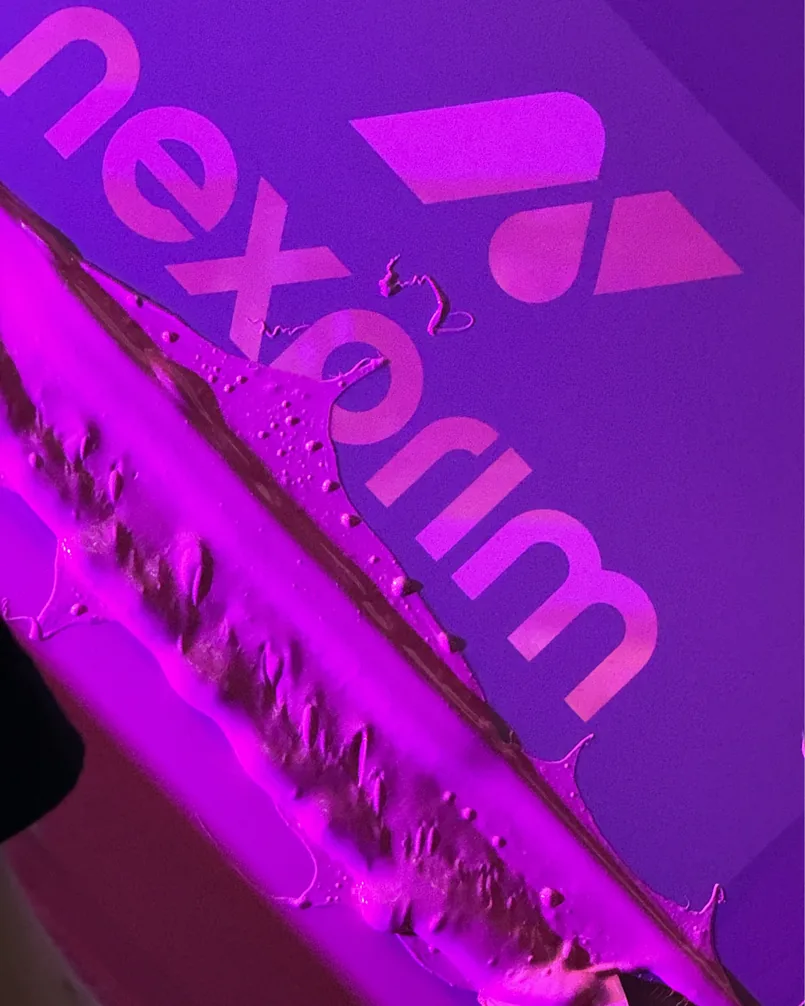
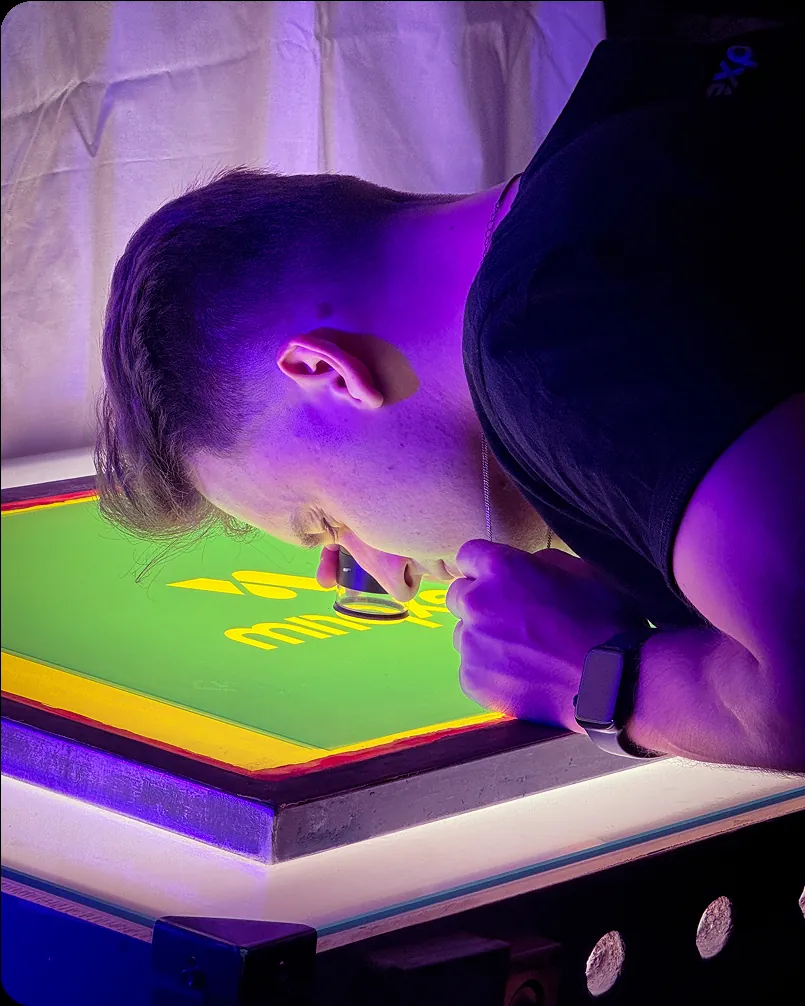
The process is very similar to classic screen printing. It starts with creating a stencil using a UV-photosensitive emulsion, through which colour is applied onto a coated polyester sheet. Each colour is fixed in a drying tunnel. After the final colour, textile adhesive is applied and final fixation takes place. The transfer is then ready to apply to textiles.
We apply our transfers on industrial membrane presses, which ensure even pressing across the whole surface. After pressing, we peel off the transfer film and re-press the print to increase its durability and fastness.
Lifespan depends on the chosen transfer type. The most basic type lasts at least 30 washes at 40 °C, though slight cracks may appear. If you need highly durable heat transfers, contact us and we'll choose the right type for your needs.
It depends on the dryer. Cheaper dryers blow air that's too hot into the drum, causing irreversible damage to the print. More expensive dryers usually don't have this problem. In general we don't recommend tumble-drying printed textiles, as drying also damages the textile itself.
No, the iron would damage the print. We recommend ironing from the reverse side. If you need a directly-ironable print, we recommend direct water-based printing or sublimation.
Yes — many customers order transfers from us, which we ship to them, and press them themselves.
Yes. Customers with smaller runs and specific placement requirements can order a transfer and press it at our premises — so they don't have to invest in presses and accessories. For 12 € excl. VAT per hour you can use our presses, with full servicing included.
The final price depends on the textile type, print placement and whether it's a repeat order with pre-made transfers or a one-off. The rough pressing price range is from 0.17 € to 1.80 € excl. VAT per print.
We currently price every order individually. To find out the price, create an order online or contact us via the contact form.
A screen-printing heat transfer provides much higher quality. Its disadvantages are a higher price for small quantities and colour limitations (price rises with the number of colours). Its advantages are a higher ink deposit — so mechanical wear has less impact — and the option to produce a specific transfer type. A DTF transfer combines one colour and one adhesive, covering a wide range of textiles, but it's unusable on specific materials such as umbrellas.
Dye migration is when the garment's own dye seeps into the pressed print and tints it — typically a white print on a red jersey slowly turns pink. Polyester is coloured with disperse dyes that activate above roughly 130 °C, when the fibres release them to the surface. Transfers are pressed hotter than that, so on coloured polyester the effect can't be avoided — but it can be blocked with an antimigration (blocker) layer printed under your colours.
Risk by material:
- Softshell — the highest-risk fabric. Microfibres have a huge surface area and elastane fibres don't hold their dye even at normal press temperature. Speckled, mould-like stains appear in the print within days.
- Sports jerseys and performance tees — usually sublimation-dyed, with loose pigment sitting right on the fibre surface. Discolouration shows fastest — within hours to days, often straight after pressing.
- Reflective vests and jackets (hi-vis) — fluorescent dyes are particularly strong migrators; light print areas quickly tint yellow or orange.
- Regular dyed polyester (fleece, windbreakers, winter jackets, backpacks) — disperse pigments are larger and migrate more slowly; tinting shows over a few weeks.
- White polyester and cotton — safe. White textiles carry no dye to migrate, and cotton isn't dyed with disperse dyes at all.
The antimigration layer works like a sponge — it traps the released dye before it reaches your colours. We recommend it on any coloured polyester, including light shades. On white textiles and cotton it's unnecessary. If you're unsure about a material, send us a sample and we'll test it. See also which textiles suit DTF.
Yes — in screen printing, colours are most often defined as Pantone.
Yes. When producing transfers we can use special inks such as fluorescent or metallic. We can also produce a 3D transfer combining additional effects.
DTF transfer
The film is 600 mm wide; the printing width is 565 mm.
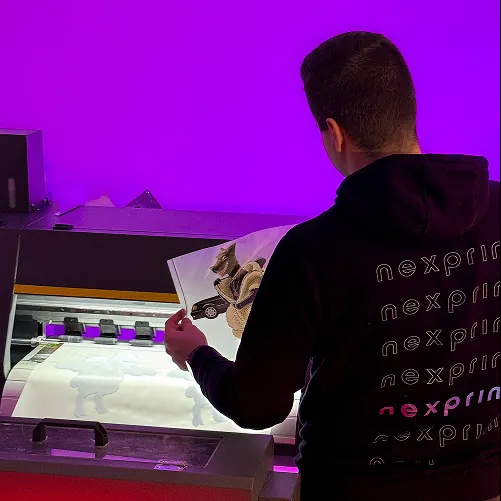
Production involves printing a colour motif onto a special synthetic film. White ink is then applied, followed by textile TPU adhesive and fixation in a drying tunnel.
Lifespan depends on the quality of application to the textile and on the wash temperature. We recommend lifespan tests, but in our experience a correctly applied print typically withstands 40 washes or more, though actual lifespan varies with fabric, application and care. If you need higher quality, consider a screen-printing transfer.
Ideally wash at 30 °C, turned inside out — this maximises the print's lifespan. When correctly applied, the print also withstands washing at 40 °C.
It depends on the dryer. Cheaper dryers blow air that's too hot into the drum, damaging the print. In general we don't recommend tumble-drying, as it also damages the textile itself.
No, the iron would damage the print. We recommend ironing from the reverse side. If you need an ironable print, we recommend direct water-based printing or sublimation.
We profile our printer regularly, but naturally the full CMYK gamut can't be achieved. If you need a specific colour, order a test print before a larger run. We can also send you our current ICC profile for soft-proofing.
We can print Pantone colours that have a CMYK representation, but only as that CMYK representation, which isn't always perfect — so we recommend a test print. For an exact Pantone colour or artwork with spot colours, a screen-printing transfer is more suitable.
DTF is at its best on cotton and cotton-rich blends. It also works on light (white) polyester, but we don't recommend it on coloured or dark polyester or on sportswear — the fabric's own dye can migrate into the print.
Why it happens: polyester is coloured with disperse dyes that become active above roughly 130 °C, when the fibres release them to the surface. We press DTF at around 160 °C, so over time the fabric's dye bleeds into the print and tints light areas in particular (for example, a white print on a red jersey starts to turn pink). On sublimation-dyed polyester (jerseys, performance tees) it can show within hours or days; on regular dyed polyester it typically takes weeks. Softshell is the highest-risk material.
Cotton doesn't have this problem. If you need a print on coloured polyester or sportswear, sublimation (on light polyester) or a screen print with a blocker layer is more suitable. If you're unsure about a material, send us a sample and we'll test it.
Pressing temperature depends on the material. For a cotton T-shirt it's usually 160 °C for 12 seconds.
Pressure depends on the material and the desired effect — we usually use 0.1 kg/cm². Higher pressure transfers the textile's texture into the print, reducing opacity but increasing resistance to mechanical damage. We recommend testing the pressure on a sample.
Cold peel is best, but our film also allows peeling while the transfer is still warm.
Yes — re-pressing through dark-brown baking paper significantly increases the print's durability. We recommend re-pressing cotton T-shirts at 160 °C for 10 seconds.
Direct screen printing
The process starts with creating a stencil using a UV-photosensitive emulsion, through which ink is applied directly onto the textile. Depending on the ink type, inter-station dryers are used between colours. After the final colour the textile goes into a drying tunnel where the ink is cured.
We use water-based, plastisol and silicone inks from leading European manufacturers. All inks are REACH-certified.
The main difference is price and durability, i.e. the quality of the final print. Water-based inks offer the best price-to-quality ratio — the print is very soft to the touch with excellent wash fastness. Silicone inks offer the highest quality (and price), with excellent coverage, hand-feel and durability.
With water-based and silicone inks, yes. For plastisol prints it depends on the dryer — cheaper dryers may damage the print with overly hot air.
With water-based and silicone inks, yes.
We currently price every order individually. For details on direct screen-printing pricing, contact us.
Yes — for direct screen printing we offer a wide range of special inks such as fluorescent or metallic. With various additives we can also achieve special effects such as the "puff" effect.
Sublimation
The process starts by printing sublimation ink onto transfer paper with an inkjet printer. The prepared print is placed on the textile and pressed at high temperature. At sublimation temperature the ink sublimates into the polyester fibres, and after cooling the pigment is locked into the fibres.
Because of how sublimation works, the printed graphic is practically impossible to wash out. The only way to "remove" it is mechanical wear of the textile itself.
No — sublimation only works on polyester. Cotton/polyester blends exist, but we don't recommend sublimating them as the colours aren't vivid enough and the print is more prone to wear.
No — sublimation inks have no opacity, so they can't be used on dark textiles.
Yes, provided the textile manufacturer permits drying per the care symbols.
Yes, provided the textile manufacturer permits ironing per the care symbols.
We currently price every order individually. For details on sublimation pricing, contact us.
We don't offer any additional special effects with sublimation.
We currently offer sublimation on textiles and mugs. If you're interested in printed mugs, contact us and we'll gladly prepare a quote.
Badges
Production involves printing the design onto waterproof synthetic or classic cellulose paper, which is then cut into circles. Component "A" of the badge is placed into a mould with the paper (and optional protective film) on top. Component "B", which already holds the pin, goes into the second mould. A transfer head presses the components together, completing the badge.
Our badges are made of galvanised metal, which is corrosion-resistant and hard-wearing. Printing is done on tear-resistant plastic paper (matte version) and on high-quality cellulose paper (glossy version, covered with a protective film).
Lifespan depends on the conditions of use. Under normal indoor use and careful handling, badges keep their finish well; heavy outdoor or rough use will shorten it.
Our badges are tested with a UV dose of 183.44 kJ/m², while the average annual dose for an individual in Slovakia is 78.75 kJ/m².
Graphic preparation
If it's only the technical preparation of the artwork for print, then no. If you need artwork changes, redrawing into a vector format, or design work, these are charged by agreement — graphic edits start at 3 €, and we generally charge 45 €/h.
For direct printing and screen-printing transfers we need vector artwork (PDF, AI, EPS, CDR or SVG). For DTF transfers and sublimation we prefer vector, but we can also print bitmap artwork of sufficient quality — we recommend at least 300 DPI, and for DTF transfers anti-aliasing turned off.
If the file won't upload, it's probably in the wrong format or too large. Check the recommended formats above in the Graphic preparation section, or contact us.
For an additional fee our designer can provide a design consultation. The price depends on the size of your order and your specific needs, and is agreed in advance.
Cart, checkout & orders
Add the products you need to your cart, then go to checkout to choose your delivery and payment method and confirm the order. You'll get a confirmation as soon as it's submitted.
Yes. You can combine different products and printing types in a single order — we ship them together once the whole order is ready. If your items have different production times and you need one of them sooner, we recommend ordering that item separately.
Enter your code at checkout and the discount is applied to your order total before you confirm. Codes can't be combined with each other, and some are limited to a single use.
You can follow every order from your account. We update the status at each stage of production and shipping, and once it's dispatched you'll get the courier's tracking details.
- Draft — saved but not yet submitted.
- Submitted — received and waiting for our review.
- Approved — confirmed and queued for production.
- In production — being printed and finished.
- Shipped — handed over to the courier.
- Delivered — received by you.
- Cancelled — the order was cancelled.
Get in touch as soon as possible. We can usually still adjust or cancel an order before it goes into production; once production has started, changes may no longer be possible.
Delivery & returns
Delivery
Postage is set by the courier and depends on the quantity and weight of the goods and the destination country. Detailed prices for each country can be found in the Delivery Policy section.
Delivery within Slovakia is usually the next day after the goods are dispatched. Delivery prices for other countries can be found in the Delivery Policy section.
Delivery within Slovakia is usually next-day even without express delivery. We offer express delivery on request and after verifying the delivery address.
You can order delivery right in the checkout to: Slovakia, Czech Republic, Austria, Poland, Hungary, Germany and the Netherlands. We deliver across the rest of the EU too — if your country isn't in the checkout list, just contact us and we'll gladly arrange transport.
Yes, you can pick up your order in person at: Textilná 7, 040 12, Košice, Slovakia.
Returns & warranty
Since the goods are made specifically for you with a unique design, returns are not possible.
Warranty conditions and the complaints procedure are stated in the Terms of Service.
If you receive a damaged shipment, contact us by phone or email as soon as possible with photo documentation, and we'll ensure the situation is resolved as quickly as possible.
Payments & prices
We accept card payments — including Apple Pay and Google Pay — TatraPay, and payment by proforma invoice. Long-term clients who pay reliably may also be eligible to pay by invoice.
We offer payment on invoice (7, 14 or 30 day terms) to long-term clients who consistently pay their proforma invoices on time and reach a minimum yearly revenue. Get in touch and we'll let you know whether you're eligible.
Prices adjust based on the ordered quantity — see our price list for details. For orders beyond the price list, contact us for individual pricing.
Yes. We run a tiered loyalty rewards program — every order earns an automatic discount, and the more you print with us over 12 months, the higher your tier. You'll find the tiers on our landing page and your own tier in your profile. For larger recurring orders we're also happy to prepare a tailored quote — just contact us.
Prices on the website are listed excluding VAT.