



Any design,
printed by the metre.
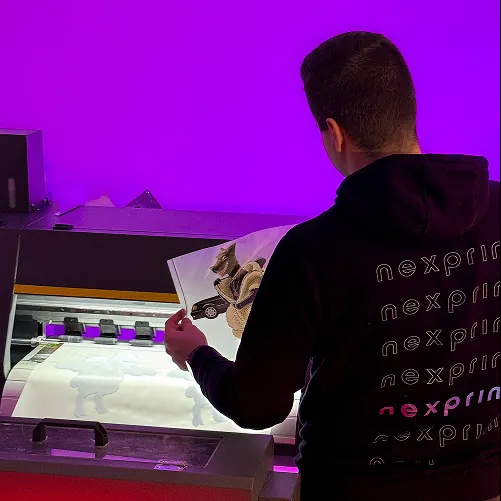
Full-colour transfers printed digitally onto film — every colour at no extra cost. The film is 600 mm wide with a 565 mm print area, and we print any length you need from 20 cm up. Press it onto cotton and cotton-rich blends, light or dark, whenever you're ready.
DTF Transfer
DTF stands for Direct-to-Film. Your design is printed in full colour onto a special film, backed with a white layer and TPU textile adhesive — a ready-to-press transfer that works on cotton and cotton-rich blends, in any colour.
Own a press? Order the film on its own and apply it yourself — any design, any length from 20 cm up, with no setup costs.
Position, press, peel
Works with any heat press — no screens, no colour separations and no minimums. The print is finished; you just apply it.
How we make it
-
1
We print the colour
Your artwork is printed in full CMYK colour onto a 600 mm synthetic film — 565 mm of it printable.
-
2
We add white & adhesive
A white underbase locks in opacity, then a textile TPU adhesive is applied so it bonds to fabric.
-
3
We cure & ship
Fixed in a drying tunnel and shipped to you ready to press — whenever you need it.
Why printers choose it
The most flexible transfer we make — for full colour, small runs and fast turnarounds.
Unlimited colour
Full-colour photos, gradients and fine detail — no extra cost per colour.
No minimum quantity
Order 20 cm or 200 metres — there is no setup cost to pay off first.
Light or dark garments
A white underbase means it pops on dark fabrics as well as light ones.
Fast turnaround
Digital printing means no screens to make — ideal for quick and repeat jobs.
The honest picture
Where DTF shines — and the few trade-offs worth knowing before you order.
Advantages
- Full-colour, no per-colour cost
- Photographs, gradients and unlimited colours print at no extra cost per colour.
- Order any length
- No screens and no setup, so a 20 cm strip is as easy to order as a full roll.
- Works on dark fabrics
- The white underbase keeps colours bright and opaque on any garment colour.
- Durable & flexible
- Correctly applied, it stretches with the fabric and, washed at 30 °C inside out, stays vibrant well past 40 washes.
Good to know
- Exact Pantone matching
- DTF prints in CMYK, so spot or Pantone colours are approximated. For an exact match, a screen printing transfer is better.
- Ironing resistance
- Don't iron directly over the print — iron from the reverse. For an ironable print, try sublimation or direct water-based printing.
- Hand-feel at scale
- A large solid print sits as a layer on the fabric. For the softest, most durable result on big runs, screen printing wins.
- Coloured polyester and sportswear
- On dyed polyester the fabric's own dye can migrate into the print over time and tint light colours. DTF is at its best on cotton and cotton blends — for coloured polyester or sportswear we'll recommend sublimation instead.
Looking for something else?
Exact Pantone, premium durability? Try screen printing →
Light polyester, print you can't feel? Try sublimation →
Want a raised, textured effect? Try 3D transfer →
What can you press it on?.
DTF is the versatile choice — it's at its best on cotton and cotton-rich blends, in any colour. A short list of the most popular.
Cotton T-shirts
Light polyester & blends
Cotton blends
Hoodies & sweats
Caps & hats
Bags & totes
Light and dark, equally bright
The white underbase keeps colours opaque and vivid on black just as well as on white.
Not for water-repellent fabrics
Heavily coated or waterproof materials can stop the adhesive bonding — ask us if you're unsure.
How to press it
We print and finish each transfer; you press it onto your textiles whenever you're ready — no minimums on your side, no waste.
1. We print your film
Your design is printed in full colour, backed with white and adhesive, and shipped to you ready to press.
2. You press it on
Position the film and press at around 160 °C for 12 seconds with even pressure.
3. You peel the film
Cold peel gives the best result, but our film also lets you peel while it's still warm.
4. You lock it in
Re-press through baking paper at 160 °C for about 10 seconds to lock in long-term durability.
How to order
From idea to doorstep in four easy steps.
-
1
Send your design
Upload your artwork and set the length you need.
-
2
See your price
The price is calculated from the length as you order — no quote, no waiting.
-
3
Confirm & pay
Pay by card or proforma invoice — production starts right away.
-
4
Shipped, ready to press
We produce your transfers and ship them to your door — press them whenever you're ready.
Specs at a glance
- Colours
- CMYK colour — photos, gradients, no per-colour cost
- Print size
- 600 mm film · 565 mm printable width
- Materials
- Cotton & cotton blends · light and dark
- Durability
- 40+ washes when correctly applied — wash at 30 °C, inside out
- Pressing
- ≈160 °C · 12 s · light pressure · cold or warm peel
- File format
- PNG / PDF with transparency · 300 DPI
Not sure which transfer?
A quick side-by-side across our printing technologies to point you in the right direction.
"Quality work at a good price, fast delivery, communication without problems. I recommend."
Radovan
"Seamless online ordering, smooth communication, fast delivery, great quality at a very good price. We definitely recommend!"
Krasimir
"Great communication, quality printing and fast processing, I am very satisfied and recommend :)"
Ivana
Frequently asked questions
The film is 600 mm wide; the printing width is 565 mm.
Production involves printing a colour motif onto a special synthetic film. White ink is then applied, followed by textile TPU adhesive and fixation in a drying tunnel.
Lifespan depends on the quality of application to the textile and on the wash temperature. We recommend lifespan tests, but in our experience a correctly applied print typically withstands 40 washes or more, though actual lifespan varies with fabric, application and care. If you need higher quality, consider a screen-printing transfer.
Ideally wash at 30 °C, turned inside out — this maximises the print's lifespan. When correctly applied, the print also withstands washing at 40 °C.
It depends on the dryer. Cheaper dryers blow air that's too hot into the drum, damaging the print. In general we don't recommend tumble-drying, as it also damages the textile itself.
No, the iron would damage the print. We recommend ironing from the reverse side. If you need an ironable print, we recommend direct water-based printing or sublimation.
We profile our printer regularly, but naturally the full CMYK gamut can't be achieved. If you need a specific colour, order a test print before a larger run. We can also send you our current ICC profile for soft-proofing.
We can print Pantone colours that have a CMYK representation, but only as that CMYK representation, which isn't always perfect — so we recommend a test print. For an exact Pantone colour or artwork with spot colours, a screen-printing transfer is more suitable.
DTF is at its best on cotton and cotton-rich blends. It also works on light (white) polyester, but we don't recommend it on coloured or dark polyester or on sportswear — the fabric's own dye can migrate into the print.
Why it happens: polyester is coloured with disperse dyes that become active above roughly 130 °C, when the fibres release them to the surface. We press DTF at around 160 °C, so over time the fabric's dye bleeds into the print and tints light areas in particular (for example, a white print on a red jersey starts to turn pink). On sublimation-dyed polyester (jerseys, performance tees) it can show within hours or days; on regular dyed polyester it typically takes weeks. Softshell is the highest-risk material.
Cotton doesn't have this problem. If you need a print on coloured polyester or sportswear, sublimation (on light polyester) or a screen print with a blocker layer is more suitable. If you're unsure about a material, send us a sample and we'll test it.
Pressing temperature depends on the material. For a cotton T-shirt it's usually 160 °C for 12 seconds.
Pressure depends on the material and the desired effect — we usually use 0.1 kg/cm². Higher pressure transfers the textile's texture into the print, reducing opacity but increasing resistance to mechanical damage. We recommend testing the pressure on a sample.
Cold peel is best, but our film also allows peeling while the transfer is still warm.
Yes — re-pressing through dark-brown baking paper significantly increases the print's durability. We recommend re-pressing cotton T-shirts at 160 °C for 10 seconds.